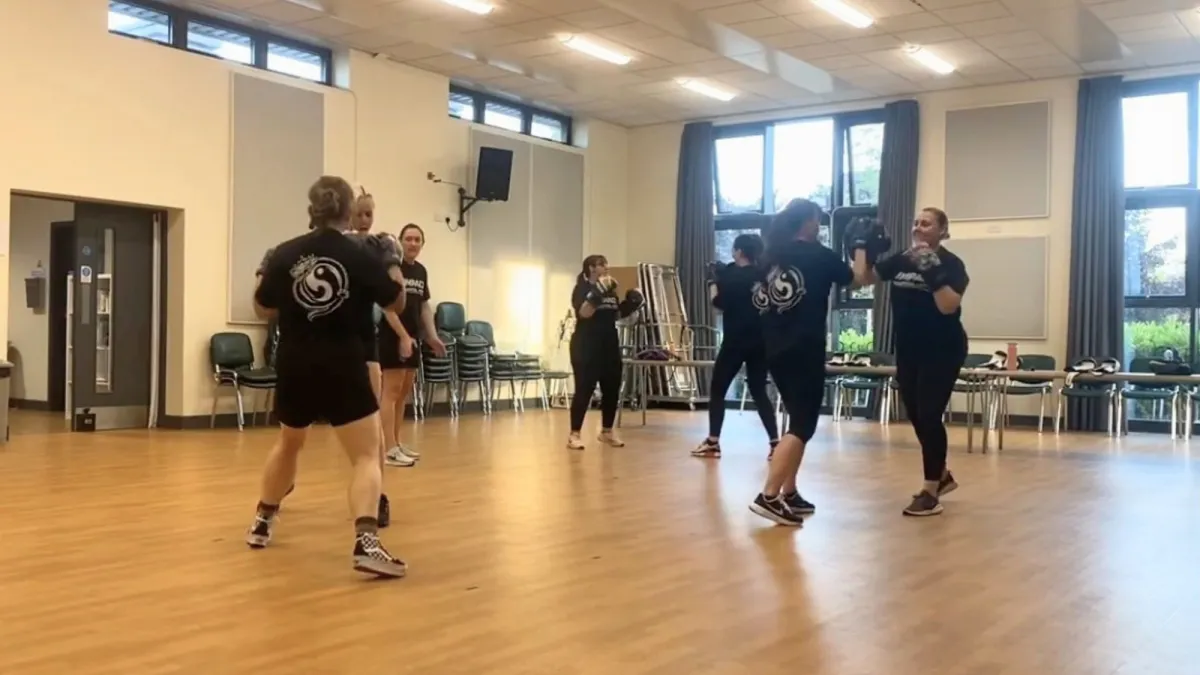
Why Women Thrive in Martial Arts
Why Women Thrive in Martial Arts
Six things the research actually shows — and why the hardest part happens in the car park.
The hardest part of martial arts isn't the training. It's turning up.
Ask any woman who trains and she'll tell you the same thing. The class was fine. The week before it was the problem.
That isn't nerves to be talked out of. It's the single best-documented barrier to women starting anything physical — and it has almost nothing to do with fitness.
Here's what the evidence says, and what happens once that first hour is behind you.
1. Confidence doesn't stay in the training hall
Twenty separate studies of women's self-defence training were pulled together in one review. They found consistent improvements in four things (Brecklin, 2008):
Assertiveness
Self-esteem
Perceived control — the sense that you have a say in what happens to you
Self-efficacy — the belief you can handle what's in front of you
A 2025 study went further, comparing women who train in martial arts against women who don’t. It found measurable differences in psychological strength between the two groups (Pekel et al., 2025).
But ask women where they notice it, and none of them say the training hall. They say meetings. They say difficult conversations. They say the moment they’d normally have let something go, and didn’t.
2. The barrier isn't fitness. It's confidence.
ukactive surveyed UK adults who aren't gym members and asked what holds them back. After cost, the answers were these (ukactive, 2025):
47% feel uncomfortable in the environment
44% say they lack confidence
Nearly half. That isn't a small nervous minority — it's the ordinary experience of being a woman thinking about walking into a room full of strangers.
Research into women's experiences of UK fitness spaces puts it in their own words: the sense of being on show, of not quite belonging, of everyone else already knowing the unwritten rules (Coen, Rosenberg & Davidson, 2021).
None of that is about being unfit. It's about walking into a room and wondering whether you're allowed to be there.
A women's class answers that before anyone has to ask it. Everyone made the same decision to come. Everyone sat in the car park for a minute first. Nobody in the room is further ahead, because there is no further ahead — there's just the group, learning the same thing at the same pace.
That's the space Impact set out to create. Somewhere you can arrive knowing nothing, ask anything, and be taught by people who remember exactly what your first week felt like.
3. One hour a week where nobody needs anything from you
Fourteen studies of martial arts training and mental health, analysed together, found small to moderate improvements in wellbeing and in internalising symptoms — the clinical term for anxiety and low mood (Moore, Dudley & Woodcock, 2020).
We'll be straight with you: martial arts is not therapy, and no training hall replaces clinical support. If you're struggling, please speak to your GP.
But for the ordinary weight most women carry — the mental load that never quite switches off — there's something specific about an hour where you physically cannot think about anything except the thing in front of you.
Women describe it as the only part of the week that belongs to them.
4. Capability arrives faster than you'd expect
A 2025 study of a structured programme for women found improvements across three areas at once: physical self-defence skills, psychological resilience, and quality of life (Yıkılmaz et al., 2025).
A few weeks won't make anyone an expert. What it builds is a base:
Awareness of what’s happening around you
The ability to create distance
Techniques you’ve practised, not read about
The habit of staying calm when something feels off
Most women don't describe the change as feeling dangerous. They describe it as feeling capable.
There's something freeing about learning it together, too. Self-defence work is hands-on — close contact, being held, practising getting free. Among women who all started the same week, there's room to laugh, to ask for a technique a third time, to stop and ask why it works. That's when it goes in.
5. Women who train together keep training
A meta-analysis comparing group and individual approaches to physical activity found that exercising in a genuine group beat both standard exercise classes and exercising alone (Burke et al., 2006).
The word doing the work there is genuine. Not people in the same hall at the same time — a group with shared goals, where people know each other’s names and notice when someone’s missing.
Women's groups tend to become that fast. Shared starting point, shared nerves, shared relief afterwards. Half the friendships form in the ten minutes before class.
That's the difference between a class you attend and a class you belong to. It's usually also the difference between still training in six months and quietly letting it slide.
6. Resilience is a skill, and it can be taught
Resilience — staying composed under pressure, pushing through discomfort, recovering when something knocks you — comes up again and again in the research on women and martial arts (Pekel et al., 2025; Yıkılmaz et al., 2025).
It isn't built through intensity. It's built through structure:
Controlling your breathing when your instinct says otherwise
Assessing a situation instead of reacting to it
Doing something badly, then again, then slightly better
Those are transferable skills. They don't stay on the mats.
What the evidence adds up to
Confidence. A steadier mind. Real capability. Resilience. And the thing that makes all of it count — actually keeping it up.
On every one of those, the research on women in martial arts points the same way.
And on the room itself, it points somewhere simple. Nearly half of women who don't train say the thing stopping them is confidence and comfort — not ability. Build a space where neither of those is in question, and the barrier is gone before the first lesson starts.
There's a limit to what reading can do.
Every woman who trains was once a woman who didn't. None of them knew how it would feel until they'd done it once. Come and try it for yourself.
References
Brecklin, L. R. (2008). Evaluation outcomes of self-defense training for women: A review. Aggression and Violent Behavior, 13(1), 60–76.
Burke, S. M., Carron, A. V., Eys, M. A., Ntoumanis, N., & Estabrooks, P. A. (2006). Group versus individual approach? A meta-analysis of the effectiveness of interventions to promote physical activity. Sport & Exercise Psychology Review, 2(1), 19–35.
Coen, S. E., Rosenberg, M. W., & Davidson, J. (2021). ‘There’s a difference between tolerance and acceptance’: Exploring women’s experiences of barriers to access in UK gyms. Wellbeing, Space and Society, 2, 100051.
Moore, B., Dudley, D., & Woodcock, S. (2020). The effect of martial arts training on mental health outcomes: A systematic review and meta-analysis. Journal of Bodywork and Movement Therapies, 24(4), 402–412.
Pekel, A., Turan, M. B., Eraslan, M., Iqbal, M., Pepe, O., Yoka, K., & Yoka, O. (2025). Building resilience through self-defense: the role of martial arts in enhancing psychological strength among women. Frontiers in Psychology, 16, 1592326.
ukactive (2025). UK Health and Fitness Market Report (analysis by Deloitte). London: ukactive.
Yıkılmaz, A., Yılmaz, C., Çiçekli, A., Eryılmaz, Ö., Budak, C., Uyar, M., Ceylan, T., Güler, Ö., & Şahin, F. N. (2025). Taekwondo exercises for women improve quality of life, physical self-defence skills, and psychological resilience. Frontiers in Psychology, 16, 1638975.